Showing posts with label Parenting. Show all posts

12.20.2010

Santa: Reject Him, Receive Him, or Redeem Him?


'Tis the season ... for parents to decide if they will tell the truth about Santa.  Read here an article by Mark Driscoll, Pastor of Mars Hill Church in Seattle, where he provides parents with a Biblical approach for redeeming the story of Saint Nicholas.  

For more information about rejecting, receiving, or redeeming cultural in general, check out this blog post by Pastor Mark.

11.05.2010

Preparing Students for College

College Ready is a good resource for pastors, parents and youth workers interested in helping prepare students for the worldly culture they will likely be immersed in on a college campus after they graduate from high school. Here's a description of the curriculum:

"College Ready can help you make the most of your college years. The six sessions of this high impact, DVD-guided series are designed to help you navigate the college maze, recognize the key areas where you'll need to succeed, and craft your own plan and personal vision. You'll be able to start right and finish well.

No one wants to stumble blindly through some of the biggest adventures and opportunities in front of them. You want to be clear. Confident. Prepared. And
College Ready can help. It offers sound wisdom, eye-opening insight, and practical advice for what's ahead—and winning there.

College can, and should be, one of the best experiences of your life—a launch pad to your future. But for that to happen, be ready.
College Ready
!"


HT: College Ready

9.21.2010

Knowing, Showing, Growing: Helping Children Know and Understand the Gospel

A new book for parents to use to communicate the gospel to their children. Here's a description of what readers are in for:

This new book by Robert J. Morgan helps parents of elementary school-age children clearly explain to their kids what it means to receive Christ as Savior, follow Him in baptism, and begin the basic habits of the Christian life (Bible reading, prayer, obedience, and witnessing). Fun, illustrated short stories with colorful characters like Mary Motley, Herman Hackler, and Lola Nola Mazola easily connect to highlight the exciting message of John 3:16, and meaningful discussion between parent and child. With its prayer suggestions, memory verses, and well-arranged content (ten chapters that require no more than thirty minutes each), the book is even suitable for Sunday school and small group settings.

Order here.

9.09.2010

Your House is a Church, You are a Priest

"Abraham had in his tent a house of God and a church, just as today any godly and pious head of a household instructs his children ... in godliness. Therefore such a house is actually a school and church, and the head of the household is a bishop and priest in his house." - Martin Luther

9.02.2010

More Teens Becoming Fake Christians

If you're the parent of a Christian teenager, Kenda Creasy Dean has this warning:

Your child is following a "mutant" form of Christianity, and you may be responsible.

Dean says more American teenagers are embracing what she calls "moralistic therapeutic deism." Translation: It's a watered-down faith that portrays God as a "divine therapist" whose chief goal is to boost people's self-esteem.

Dean is a minister, a professor at Princeton Theological Seminary and the author of "Almost Christian," a new book that argues that many parents and pastors are unwittingly passing on this self-serving strain of Christianity.

HT: Pure Church

8.25.2010

The Responsiblity of Parents Toward Their Children

The Bible consistently and explicitly lays upon parents the primary responsibility for teaching and modeling God's truths to children. It is crucial that there be a clear understanding of the primary role parents have in the training of children, so that the biblical responsibility given to parents is not ignored and laid on the church.

The most striking thing is that parents are constantly charged with the primary responsibility for the training of their children. The great command of the Bible is to “love the Lord your God with all your heart and with all your soul and with all your might” (Deuteronomy 6:5; see also Matthew 22:37). These words “shall be on your heart” (Deuteronomy 6:6). Then Moses tells us, “and you shall teach them diligently to your children and shall talk of them when you sit in your house and when you walk by the way and when you lie down and when you rise up” (Deuteronomy 6:7; see also Deuteronomy 11:18-21).

There are at least two implications from these verses. First, Moses teaches adults the Word of God, and the adults are then expected to pass it on to their children. Second, adults will only be effective teachers if these words are “on their heart.” If these words are on their hearts, adults will be able to teach their children in every situation of life, whether they are sitting, walking, or lying down. This point is utterly crucial. What parents end up teaching children is what they (parents) treasure and love. If they love God with all their hearts, they will seek to instill that love to their children in every situation which arises. Therefore, the most important thing the church can do for children is to trumpet a vision of God and nurture adults in the wisdom of the Scriptures.

But then, the question must be asked of parents, "Parents, what's on your heart?"  What are your actions, habits, and priorities teaching your children?  Does the way you live your life lead your children to an understanding of what it means to pick up your cross daily and deny your-self?  Does your life tell your children that God is everything to you?  Or does your life say to your children that God is an afterthought - He's who you go to when you have time?  Maybe it's time that you ask yourself, "Could it be that I'm more SELF-conscious than God-conscious?"

Or better yet, maybe it's time for church leaders to start asking that question to the members of their own congregations.  The church does a great disservice to families when they don't call out parents, in a loving way, about the way they're living their lives.  It's a sad fact that the church today fears offending people more than anything, and so church leaders make excuses for parents like, "They would come to Sunday School, but they're really busy" or "They used to serve, but they're going through a lot right now."  Both statements may be true, but if those patterns go on year after year, then maybe it's not a busyness issue, maybe it's a spiritual issue.  Churches all over the country are sending people to Hell with a smile and a cup of coffee simply because the leaders don't want to offend anyone - and that may be greatest offense of all.

Parents search your hearts.  Evaluate your lives.  Try to discern what lessons you are implicitly teaching your children each and everyday by the choices you make and the words you use.  Strive to live for Christ.  Teach your children the gospel not only from God's Word, but also from the way you live.  And make no mistake, your children are watching you.  Be a model of Christ's love to them.  Take up your cross in your home daily, deny your SELF, and lead your kids to Christ.

6.25.2010

3.17.2010

10 Ideas for Living the Gospel in Your Home

In Philippians 3:8-9, Paul proclaims the centrality of the gospel—the cross—to life.

I count all things to be loss in view of the surpassing value of knowing Christ Jesus my Lord, for whom I have suffered the loss of all things, and count them but rubbish so that I may gain Christ, and may be found in Him, not having a righteousness of my own derived from the Law, but that which is through faith in Christ …

If the gospel is central—to the point that all else is rubbish—it also must be central in my marriage, my home. Practically, here’s what that may look like as I shift my family’s culture.

1. Repent. A family that practices repentance keeps “short accounts” with each other, apologizing quickly and sincerely. The point of apologizing to my kids even when they’re in trouble isn’t at all to distract them from their sin. They need to grow up with my willing confession as the norm, to give them the knowledge that Mom requires a Savior as much as they do. An awareness of the log in my eye—even when my children or spouse are the offenders—is biblically commanded (Matthew 7:1-5).

2. Forgive. Deliberately ask for forgiveness, and then humbly and verbally extend forgiveness: “I want you to know that I completely forgive you, and that I believe God forgives you, too.”

I guess it can sound a little hokey when we’re not used to using such language in our homes … but that’s my point. Should it be? Call me an idealist, but I’d like this replication of Christ’s words to become the norm, a chance to apply the gospel to myself and my loved ones daily.

Conflict is an opportunity to glorify God, love others, and become more like Christ. Conflict allows the gospel to be played out in our midst: loving by laying down our lives in the midst of our family members’ sin. Forgiveness rolls out the red carpet for us to witness the gospel again and again with those we love the most.


2.01.2010

The Purpose of Family Worship

God has called His people to Himself. He has called His people together that they may love Him and worship Him. This is true in the Old Testament as well as the New Testament. Jesus said, “My Father is seeking worshipers who will worship Him in spirit and in truth.” — Deuteronomy 6:4-9

The purpose of family worship is to help husbands and wives and children and grandchildren to love and worship their Heavenly Father. Our worship is not just to take place on Sundays, but throughout the week. The Family Worship and Devotional Guide is meant to help you and your family worship our Heavenly Father during the week, by reminding you of what you saw and heard during Sunday worship with the larger body.

Creative ideas and tips on how to engage with kids in family worship:
  • Make your time joyful
  • Remember, it’s primarily about a relationship, not a task to scratch off
  • Have fun
  • Adapt as you go along – call audibles
  • Do what is age and maturity appropriate
  • Delegate some of the responsibilities
  • Don’t take yourself too seriously
  • If you fail, start again immediately
  • Leave them wanting more
  • Be consistent
  • Pick a fun place to have it in the house and maybe rotate – closet, fort, bedroom, car, etc.

HT: PCPC

1.29.2010

Coal Train Railroad: New Jazz Album for Kids


Thanks to Abraham Piper for introducing me to this new jazz album for kids. My daughter loves listening and dancing to the Coal Train tunes and I have to admit I like it too. I highly recommend this album to those of you with little ones around.

1.27.2010

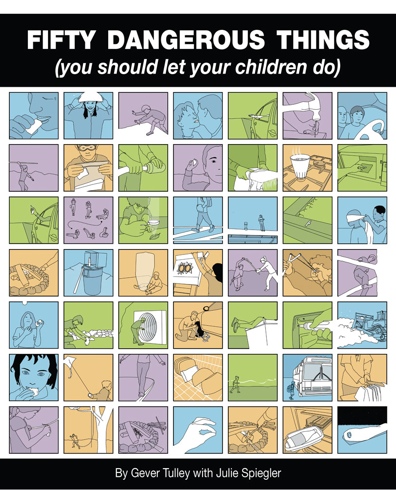
50 Dangerous Things You Should Let Your Children Do


There's no question that there is a tendency among parents to remove all struggles from their children's lives and protect them from anything and everything that might potentially harm them.  Before my daughter was born I used to criticize parents for this, but it's different now that I stand on the other side of the fence.  Still, we need to find a balance between protecting our kids and allowing them to explore, have fun, and experience difficulties that will help them learn and grow.  "Fifty Dangerous Things You Should Let Your Children Do," know doubt picks up on our over-protective tendencies, offering some "dangerous" things we can do with our children that are interesting, eye-opening, enlightening or just plain fun! 

Here's what the authors have to say about danger: 

"And while there are aspects of danger in virtually everything we do, the trick is to learn how mastery actually minimizes danger. Walking is dangerous when we start as babies, but we persevere and it becomes safe. Next we learn to negotiate stairs. Why stop there? Why not practice and become proficient at walking on the roof or walking on a tightrope? These are just a few of the Fifty Dangerous Things that we invite you to try."  

Check out the website for the book, fiftydangerousthings.com

12.10.2009

Why Require Unregenerate Children to Act Like They're Good?

John Piper writes:

If mere external conformity to God’s commands (like don’t lie, don’t steal, don’t kill) is hypocritical and spiritually defective, then why should parents require obedience from their unregenerate children?

Won’t this simply confirm them in unspiritual religious conformity, hypocritical patterns of life, and legalistic moralism?

Here are at least three reasons why Christian parents should require their small children (regenerate or unregenerate) to behave in ways that conform externally to God’s revealed will.

11.02.2009

The Valiant Wife of Proverbs 31

Recently Joshua Harris preached from Proverbs 31, highlighting four characteristics of the valiant woman, in order of importance:

She fears the Lord.
She gives her life away.
She is capable.
She is influential.

Options:
Listen online or download an mp3 of the message.
Download a summary outline in PDF format.
• Use the following questions prepared by Don Devries to reflect on how to apply the message to your life.

1. A godly woman knows and fears the Lord. Is there anything you are living for--personal success, a husband, your children, etc.--more than you are living for God and His Kingdom?

2. Josh taught us that the Proverbs 31 woman is capable. How can this chapter stir godly ambitions for the Lord?

3. As Josh taught, the Proverbs 31 woman gives her life away. Is there need around you that the Lord is calling you to help meet?

4. Concerning godly womanhood, are you following what the world values or are you valuing what God says is praiseworthy?

5. In what one Proverbs 31 quality would you like to grow?

6. Men, how can you encourage, cherish and honor the values of womanhood described in Proverbs 31?

HT:
Joshua Harris


10.06.2009

Pastor Daddy

Pastor Daddy teaches preschool children the Christian doctrine of the home as a “little church” where the father teaches his children God’s commands and leads them to worship the one true God.

Order here.

10.02.2009

Gospel-Centered Parenting: A Review By Challies

Tim Challies recently reviewed Bill Farley’s new book Gospel-Powered Parenting, which he highly recommends for parents to consider checking out. After completing his review, Challies contacted Farley and asked him to address a few questions. Below is the first question and Farley's answer - I particularly appreciate the distinction between making good behavior the "main thing" or parenting vs. recognizing new birth as the "main thing." Amen!

1. Why the gospel? Why is the gospel the key to empowering parenting? What is the connection between the words “gospel” and “powered?”

Paul tells us that “the gospel is the power of God for salvation to everyone who believes” (Rom. 1:16). We hear this verse and think the pulpit or witnessing, but parents should hear this and think family devotions. Parents convinced that God’s power is latent in the gospel center their families around the gospel. They are convinced that it provokes new birth, that it will knit their children’s hearts to God, and motivate godly behavior. Our children receive the “imperishable seed” of new birth through the message of the gospel (1 Pet. 1:23). Often parents don’t center their parenting in the gospel because either they don’t really understand the gospel, or they don’t believe that God’s power is latent in the gospel.

The gospel also protects parents from “moralism,” the idea that well-behaved children are the main thing. New Birth is the main thing. The morality of Christ imputed to your children is the main thing. It is not what our children do for Christ but what Christ has done for our children that is the main thing. Ironically, without aiming at it, gospel centered parents get godly behavior from their children.

In addition, the fear of God is the key to attracting God’s favor upon our parenting. Many think that the fear of God is an Old Testament concept. But the main place we get the fear of God is at the cross of Christ—the heart of the gospel.

Read the entire interview here and Tim's review of the book here.

9.23.2009

Preaching & Teaching the Kingdom to Our Children

Our parenting conference this past weekend was wonderful. We were blessed to have Rev. Stephen Smallman join us for the weekend and encourage us from God's Word. His final message to us was, in my opinion, the best and most challenging of all. You can download his sermon, Preaching & Teaching the Kingdom to Our Children, for free here. If you're parent, pastor, or Christian Education leader, you will want to hear this message.

Later in the week I will post my notes from the conference; and in the coming weeks I hope to add a review Steve's newest book, The Walk, which is available now and has received high praise from early readers, including Tim Keller.


9.07.2009

How Our Children Come to Faith: Free Seminar in Des Moines, IA with Stephen Smallman

Conference Schedule

Friday September 18th // 6:30 to 8 p.m.
"Understanding Our Own Conversion Experience and the Place of Christian Community" (Matthew 18:3)

Saturday September 19th // 9 a.m. to 12 (Noon)
"How Our Children Come to Faith: Regeneration and Conversion" (Matthew 19:14a)

Sunday September 20th // 10:30 a.m. to 12 (Noon)
"For of Such is the Kingdom of Heaven: Teaching and Preaching the Gospel of the Kingdom to Our Children" (Matthew 19:14b)

This conference is free of charge and child care will be provided. For more details please visit westkirk.org
or if you would like to register, click here.

New Book By Stephen Smallman - The Walk


Stephen will be speaking at our church September 18-20, 2009 on the topic of how children come to faith. The conference is free and if you are interested in attending please click here.


8.27.2009

Discipleship Begins at Home, Part 2

Start Early

You can and should teach your children basic Christian beliefs and how to memorize Scripture. This can be both fun and educational. You can choose short Scriptures to begin teaching your children. As you continue to learn the Scriptures, you can use longer passages such as the Ten Commandants and 23rd Psalm for when you and your children feel ready to go deeper. You can also use a short family catechism with questions and answers for you to discuss together that will help your children learn basic Christian doctrine.

Some Practical Ideas

Here are a few practical ideas that may help you disciple your children.

  • Find a good children’s Bible.
  • Remember to have fun with your children while learning the Bible.
  • Keep the time brief to hold the child's attention.
  • Recite the verse several times a day in your child's presence so it becomes familiar to them.
  • Make flash cards with Scripture on one side and the book, chapter, and verse on the other.
  • Put the verse to music or rhythm. Your child will enjoy singing and clapping their hands.
  • Think of fun activities to make the verse fun and easy to remember.
  • Tell them you are proud of them and have them recite it to someone else, like a grandparent or teacher.
  • Pray with your children every day at meals and before they go to bed at night.

The Revolution Begins at Home

If we want a revolution of discipleship in our nation, it will have to begin in our homes. Discipleship begins in our marriages, by loving our spouses with the love of Christ. It happens by teaching, loving, and disciplining our children. When we bring the gospel back in the home, it will spread through our neighborhoods and into the communities where we live. If every family in every church got serious about making disciples in the home, it would change our world.

The great Puritan pastor Richard Baxter knew the importance of family ministry. He said, “We must have a special eye upon families, to see that they are well ordered, and the duties of each relation performed. The life of religion, and the welfare and glory of both the Church and the State, depend much on family government and duty. If we suffer the neglect of this, we shall undo all…. I beseech you, therefore, if you desire the reformation and welfare of your people, do all you can to promote family religion.” Let us not neglect our duty to disciple those who are within our very homes.

8.20.2009

Discipleship Starts at Home, Part 1


By
Winfield Bevins

“A house is actually a school and a church, and the head of the household is a pastor in his house.” – Martin Luther, The Great Need

I am the lead pastor of Church of the Outer Banks, located in Nags Head, NC. I am the husband of an amazing wife and the father of two incredible little girls. More than ever before, I see the importance of integrating faith in the home every day. Statistics for divorce are rising at an alarming rate. Statistics also show that between 70 and 88 percent of Christian teens will leave the church by their second year in college. More than ever, it is time for us to step back and rethink the importance of discipleship in our own homes.

Don’t Neglect Your Family

What good is it if you make disciples of your neighbors, co-workers, and friends, yet neglect to disciple your own family? This is what Paul meant when he said, “If a man does not know how to manage his own household, how will he take care of the church of God?” (1 Tim. 3:5). This Scripture is not just for pastors, but is also applicable for all Christian parents. The reality is that we are not putting enough focus on discipling our own families, and instead we tend to leave the responsibility to the church.

Disciple Your Children

The call to “make disciples” begins in our homes first. It is our spiritual responsibility as parents to teach our children about the faith. The Bible tells parents, “Train up a child in the way he should go; even when he is old he will not depart from it” (Prov. 22:6). As Christian parents, we should desire for our children to have a firm foundation and grow up to love Jesus and know what the Bible says about their lives.

Faith as Routine

Faith is not just something that we do once a week, but should be incorporated into the daily routines of the home. David Wegener said, “Reading and memorizing Scripture and the catechisms of the church results in incredible development of children, both spiritually and intellectually… What families regard as important is evidenced by the manner in which they spend their time.” How do we spend our time? Watching TV, playing video games, or shopping? Sadly, many families devote more time to these things than they do teaching their children about God, or just simply spending quality time together.

It’s Our Responsibility

It is not the churches’ or schools’ responsibility to raise our kids. Too often, we think that the church is more like a baby-sitting service to watch our kids for a few hours a week while we enjoy the worship service. While church is important, the Bible tells us that the home is the primary place of learning the Bible and moral instruction. In Deuteronomy 6:4-9, we read:

You shall love the LORD your God with all your heart and with all your soul and with all your might. And these words that I command you today shall be on your heart. You shall teach them diligently to your children, and shall talk of them when you sit in your house, and when you walk by the way, and when you lie down, and when you rise. You shall bind them as a sign on your hand, and they shall be as frontlets between your eyes. You shall write them on the doorposts of your house and on your gates.

HT:
The Resurgence